
Home

Joseph Jude

Cover photo
Profile photo
Joseph Jude @jjude

I use Twitter as a commonplace note: https://t.co/vPr6DeA0d4 CTO In Sales • Homeschooling dad Building @siteaudittools & @thoughttonote

India Joined Feb 1, 2008
Joseph Jude
Joseph Jude @jjude
In reply to @jjude

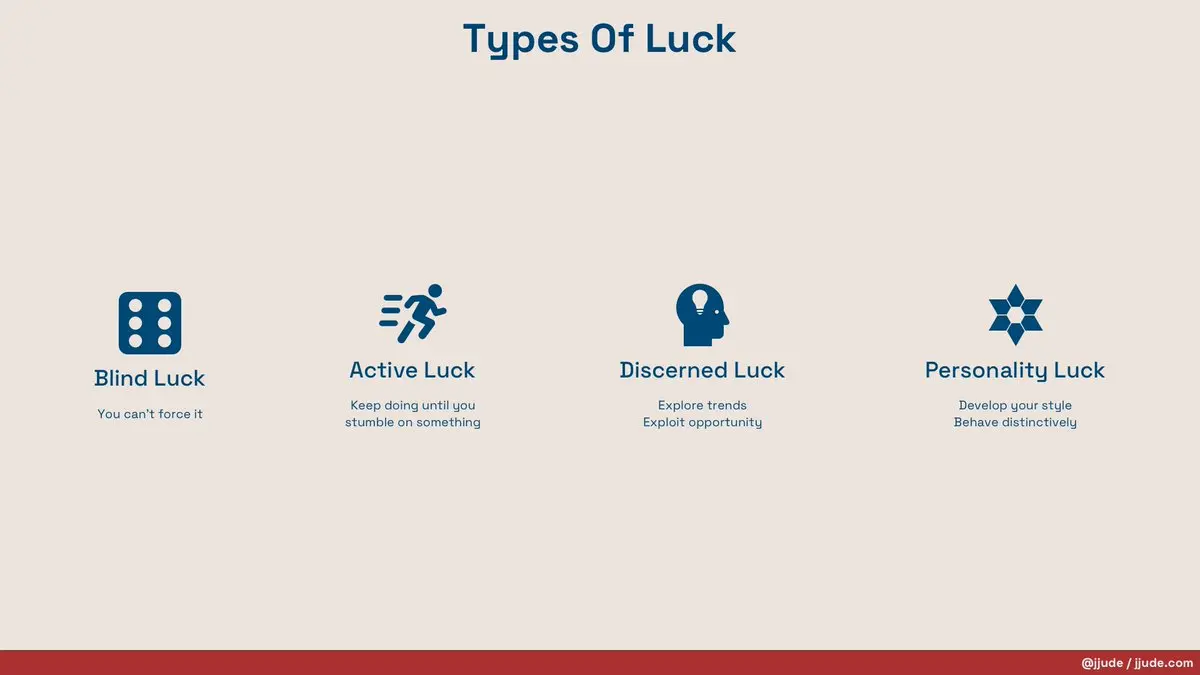
James Austin took the pain to classify luck in his book, Chase, chance, and creativity. He say there are four types of luck. • blind luck • active luck • discerning luck • personality luck 👇
Joseph Jude
Joseph Jude @jjude
In reply to @jjude

As @morganhousel says, Luck is just flip-side of risk. If you accept that hypothesis, then we can classify luck and deal with it as we deal with risk. Don't you agree? 👇

Joseph Jude
Joseph Jude @jjude
In reply to @jjude

If I asked you the question, why you take insurance, I'm sure you'll say, bad things happen in life. So I'm signing up for insurance to protect my family, life, and other assets. Good point. We have become so good in categorizing risks and mitigating those risks. 👇

Joseph Jude
Joseph Jude @jjude
In reply to @jjude

If you like these tweets, don't forget to follow me. Don't hestitate to ask any questions too.

Joseph Jude
Joseph Jude @jjude
In reply to @jjude

Once you find what you like and what you comes naturally to you, it is time to take a side. I found out that I love technology and teaching. So I got into tech consulting, coaching (Gravitas WINS - ), and public speaking.

Joseph Jude
Joseph Jude @jjude
In reply to @jjude

By doing this, you would learn quite a lot about most of the business functions. You will also know what you like the most and what comes easily to you.

Joseph Jude
Joseph Jude @jjude
In reply to @jjude

So the answer is: Learn as much as possible in the early part of your career. If you get a chance to work in marketing department, do it. If your company asks you to develop a server application, develop it. If you come across an opportunity to sell, sell.

Joseph Jude
Joseph Jude @jjude
In reply to @jjude

Sivers in an interview with Tim Ferriss says this: When you’re earlier in your career I think the best strategy is you just say yes to everything, every piddly little gig, you just never know what are the lottery tickets. Read the entire interview:

Joseph Jude
Joseph Jude @jjude
In reply to @jjude

If you liked this thread, don't forget to follow me. I write a weekly newsletter where I share strategies and techniques to build flywheels of success. Subscribe here:

Joseph Jude
Joseph Jude @jjude
In reply to @jjude

6. Commensurate Compensation Some would consider the pay pie. I realized long back, money is essential but not the only necessity in life. Pay package should commensurate with the outcome. If not it leads to irritation, not joy at work.

Joseph Jude
Joseph Jude @jjude
In reply to @jjude

5. Flexible Hours 9 to 5 work hours is a terrible inheritance from industrial revolution. Ideas don’t come within a fixed block of time. Flexible hours doesn’t mean lethargy. It just means I am free to work when I work the best.

Joseph Jude
Joseph Jude @jjude
In reply to @jjude

4. Appreciative Clients Often a single appreciation from the client can make you forget all the pain of the assignment, especially if the recognition is public. Not many clients do it but when done right, you are energized.

Joseph Jude
Joseph Jude @jjude
In reply to @jjude

3. Co-operative Team Despite the hype built around leadership, successful leaders aren’t loners. Behind every triumphant leader, there is a hard-working team. Through the highs and lows of the assignment, it is the team that makes the journey joyful.

Joseph Jude
Joseph Jude @jjude
In reply to @jjude

2. Supportive Boss Corporate structure is hierarchical and our immediate boss is an important link in that structure. If he is a pointy-haired boss, life becomes awful. But it is a pleasure to work with those who give you freedom and support to make you and them a success.

Joseph Jude
Joseph Jude @jjude
In reply to @jjude

1. Stimulating Work I enjoy those assignments where I apply my knowledge but I enjoy more when there is an opportunity to learn new things. The tension between being stretched and being a failure is what makes an assignment challenging and thus enjoyable.

Joseph Jude
Joseph Jude @jjude
In reply to @jjude

My ideal job as one having all of the 6 factors. Read on, comment, and importantly follow me :-)

Joseph Jude
Joseph Jude @jjude
In reply to @rishabh_grg

@rishabh_grg As @naval says: code + media = wealth Increase your skills in code & media. Doesn't mean you've to be coder. Just need to know tools to achieve results you are after. Improve your media production - podcasts, blogs, video. Use tech (code) to accelerate. Build your media empire

Joseph Jude
Joseph Jude @jjude
In reply to @jjude

As a software engineer, I loathed networking. Once I understand what it is and the power of it, I can't stop talking to people and help them have a great day.

Joseph Jude
Joseph Jude @jjude
In reply to @jjude

Law of reciprocity plays an important role in increasing the number of people who wants you to succeed. Law of reciprocity requires: - giving to the group - abundance mindset - actively seeking out opportunities to help others

Joseph Jude
Joseph Jude @jjude
In reply to @jjude

Put together a hit list of 50 people you’d like to stay in touch with this year. Ever since I read this, I have made a list of nice folks and covering that list 3 per week. Joining active community like @visualizevalue helps

Joseph Jude
Joseph Jude @jjude
In reply to @jjude

Phases of growing relationship: visibility, credibility, and profitability - Visibility: create recognition & awareness - Credibility: walk the talk; talk with your results - Profitability: If it doesn’t profit both partners, it will not endure

Joseph Jude
Joseph Jude @jjude
In reply to @jjude

Success is social: all the ingredients of success that we customarily think of as individual — talent, intelligence, education, effort, and luck—are intertwined with networks

Joseph Jude
Joseph Jude @jjude
In reply to @jjude

If you are an introvert, become a “situational extrovert” - be a loner, reserved ardound strangers, but very outgoing in the right context. Helped to get my perspective right. I'm an introvert; realised don't have to be one all the time.

Joseph Jude
Joseph Jude @jjude
In reply to @jjude

Networking is about nurturing mutually beneficial relationships nurture - nurture as a plant mutually - both sides benefit beneficial - not one dimensional; not only about $$$ relation - not a transaction, but a relation Invest in their success as they invest in yours

Joseph Jude
Joseph Jude @jjude
In reply to @jjude

Follow me to learn about building flywheels of success for your career and life.

Joseph Jude
Joseph Jude @jjude
In reply to @jjude

Unless the problem is not clear, don't lauch. You can evolve other things as you proceed through the journey and fine-tune it, but if you don't understand different aspects of problem, you won't be able to solve it. I wrote about it here in detail:

Joseph Jude
Joseph Jude @jjude
In reply to @jjude

Finally, what is your REWARD? What is in it for you? What will you get out of offering this solution to your audience? Is it fame, fortune...

Joseph Jude
Joseph Jude @jjude
In reply to @jjude

Price is an important point of the offer. Your solution might solve their problem and transform their lives, but if it is way too high or way too low, the audience won't latch on to your solution.

Joseph Jude
Joseph Jude @jjude
In reply to @jjude

What is the TRANSFORMATION your audience will experience if they take up your OFFER? Is it a delta improvement? Or will it transform their life so much they will be jumping with joy and run through the street telling everybody? What is your OFFER?

Joseph Jude
Joseph Jude @jjude
In reply to @jjude

The SCENARIOS in which they feel the problem. Scenarios tell you the frequency and severity of the problem. Is it a daily problem? Is it an annual problem? If it is an annual problem, do they feel it so severely that they will pay for it?

Joseph Jude
Joseph Jude @jjude
In reply to @jjude

Some will feel the problem and want it to be solved. Others might find ways to live with it. Some others don't care about the problem. The first set is your immediately addressable audience. Talk to them. Only then you'll understand ...

Joseph Jude
Joseph Jude @jjude
In reply to @jjude

I always start with the PROBLEM I'm trying to address with the new venture. If the problem is not clear, I dig deeper, talk to others until I am clear about the problem. The problem should need a pain-killer, not a vitamin. Next is AUDIENCE, who feel the problem.

Joseph Jude
Joseph Jude @jjude
In reply to @jjude

I've used this strategy whenever I have to intervene in any troublesome project. Assemble a small, committed team; discuss with them different ways of operating; but give them autonomy to operate at the moment of decision; review regularly. Has worked well so far for me.

Joseph Jude
Joseph Jude @jjude
In reply to @jjude

In a book on Alexander, the author Partha Bose, says Alexander operated with a small army who bonded well together. So they could surprise the enemy with last minute changes in plans. Because the team worked together, they could follow the change of plans well.